Main

August 12, 2008

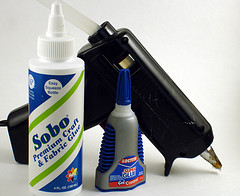
Glue FavesMickey was making compacts with polymer clay on top, and she e-mailed me to ask which glues work best:

"They say E6000 pops off easily and Crafter's Pick Ultimate Glue also pops off. Any suggestions?"

As the good folks over at This to That will tell you, glue choices depend a lot on what you're gluing together. Not every glue works well for every surface. But here are a few of my favorite glues to use with polymer clay:

Continue reading "Quick Tip: Which Glues Work Best with Polymer Clay?" »

July 2, 2008

Faux Leather Monogrammed Coaster SetI love that Irene Semanchuk Dean's Faux Surfaces in Polymer Clay book has two parts for each imitative surface: first a recipe, then a project. Not only does she show you how to mix up a realistic-looking mother-of-pearl, but she also shows you how to incorporate that into a typical mother-of-pearl inlay project, enhancing the perception that it's the real thing.

Her book helped me look at faux in a whole new light. It's not only how good the surface looks — it's also what you do with it. Your faux turquoise surface may look perfect, but you have to consider shapes and sizes of natural turquoise if you want to really hit the mark with your finished project. If a stone is typically carved, then digging out your carving tools after baking will help make it look more realistic.

And the same applies to leather. If you lived through the 70's, you probably had a leather kit with carving tools and hand stamps. So what says leather more than those familiar motifs?

Leather Stamp SetAvailable at some craft stores or online, leather-working tools are a great addition to your polymer clay stash, especially if you want to give faux leather a realistic look. The nice part is that polymer clay takes the impression of these stamps much more easily than leather. (If you have trouble with the metal tools sticking to your clay, try dusting the clay with cornstarch or spritzing it with water first.)

Some of the tool kits also include patterns. Mine had great tips for combining individual stamps to create borders and other designs. Using their ideas made it easy to create good-looking designs that have a definite leather look to them. (You can also find free leather patterns on Tandy's site.)

I got my set of 7 Tandy leather tools at my local Hobby Lobby for $16.99 and have really enjoyed them. Combine these tools with this great leather recipe from Polymer Clay Web for a fun faux leather look.

June 20, 2008

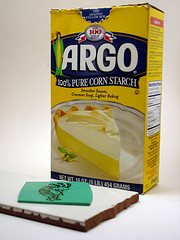
Using Corn Starch to Prevent Air BubblesDon't you just hate air bubbles? Your polymer clay piece may look perfect when you put it in the oven, but then those air bubbles appear during baking and ruin the look. There are various ways to prevent bubbles, such as conditioning the clay properly (don't trap air inside clay folds as you run it through your pasta machine), or looking for and popping air bubbles trapped when you're covering something with clay.

But my tip today is specifically for the air bubbles that are created when you're baking a flat sheet of clay — the sort of sheet you might use for stamping or scrapbooking punches or for Artist Trading Cards. I've found that, especially if I work on the same surface I'm baking on, the clay may stick to the baking surface in places. It's easy to trap air in the places where it's not stuck, in which case the sheet may end up as a bubbly and not-so-flat sheet after baking.

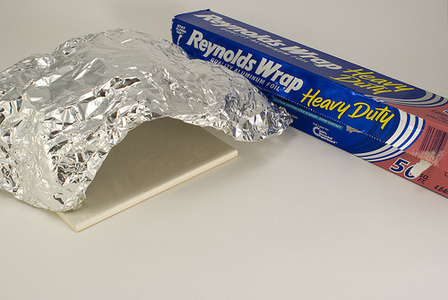
Here's how to prevent those air bubbles. Put a light dusting of cornstarch all over your baking tile. The cornstarch will prevent the polymer clay from sticking to the tile, which helps prevent the bubbles.

If you're working and baking on the same tile, try lifting the polymer clay sheet up before baking to make sure it's not stuck. Dust with cornstarch before you replace the polymer clay sheet.

Once you've baked the clay, you'll want to wash and sand off any extra cornstarch, at least if the back of your clay sheet will be visible in your project. That may mean an extra step if you're not normally a sander. Still, I find this is much easier than trying to sand down the air bubbles that would otherwise appear on the project's surface!

I've been dusting my baking tiles with cornstarch for a while now and have noticed a definite improvement. Give it a try & let me know if it works for you!

May 16, 2008

Box of Pearl and Embossing PowdersHere's a quick tip for storing your Pearl Ex & embossing powders so it's easy to find the right color at a glance.

I used to store my Pearl Ex powders in their original box, carefully organized numerically (because I'm picky that way). However, when I reorganized the last time, I found that it made more sense to keep all the pearl & embossing powder bottles together in one large box. While this worked much better from a storage aspect, it created two new problems:

  • It was trickier to keep them in just the right order, something that was important if I was using my Pearl Ex Color Strip to find the right color.
  • The original Pearl Ex boxes stored the bottles vertically, so I could see the color from the side. In my new storage box, all I saw was their little black lids, which all look exactly the same.

To fix these problems, I spent a little time creating samples and labelling the lids:

Continue reading "Quick Tip: Organizing Pearl Ex & Embossing Powders" »

May 14, 2008

A Perfect SquareNeed to cut a polymer clay square but don't have the right size cookie cutter? Here's an easy way to get a perfectly straight-edged square (or rectangle) every time:

  1. Step 1: Find graph paperFind a sheet of graph paper. If you don't have any -- or if the grid on yours is the wrong size to be useful -- you can print your own graph paper online, selecting just about any size grid you like. If you know what size you need your polymer clay square to be, count out how many squares that equals on the grid (i.e., 7 across by 7 down). It may be helpful to outline the edges with a pen or highlighter, especially if you'll be re-using the template to cut lots of pieces the same size.
  2. Step 2: Lay clay on wax paperPlace the graph paper under a sheet of wax paper. (Working directly on the paper could lead to an accidental image transfer.) Roll out a sheet of clay to the desired thickness, and lay it on top of the wax paper. It helps if you press it down lightly so it sticks to the wax paper -- that way it won't wiggle while you're cutting.
  3. Step 3: Cut the ClayLine up your clay knife with the grid lines, and cut out your square. Viola -- perfect every time!

This post is the first in a new category on my blog: Quick Tips. It'll be a spot for me to jot down interesting observations & quick tricks I've found useful -- and with any luck, a spot where you'll discover some new things now & then too!

About this Site

CraftyGoat's Notes is all about sharing tips & techniques for paper crafts, hemp jewelry, and polymer clay crafts.

Read more about CraftyGoat's Notes...

Archives

Enter your address to get CraftyGoat's Notes by email:

Delivered by FeedBurner